Algebraic Structures and Groups
(代数系と群)
Discrete Mathematics I
11th lecture, December 5, 2025
https://www.sw.it.aoyama.ac.jp/2025/Math1/lecture11.html
Martin J. Dürst

© 2006-25 Martin
J. Dürst Aoyama Gakuin
University
Today's Schedule
- Summary and homework from last lecture
- Algebraic Structures
- Groups
- Group axioms
- Examples of groups
- Permutations and symmetric groups
- Cayley tables
- Group isomorphism
- Simple group theorems
Summary of Last Lecture
Binary relations on a single set (A) can have the following
properties:
- Reflexive: Each element is related to itself (∀x∈A:xRx)
- Symmetric: Elements are related both ways, or not at all (∀x, y ∈A:
xRy ⇔ yRx)
- Antisymmetric: Elements cannot be related both ways (∀x, y ∈A:
xRy ∧ yRx ⇒ x=y)
- Transitive: If x is related to y, and y
is related to z, then x is related to z
(∀x, y, z
∈A: xRy ∧ yRz ⇒
xRz)
A relation that is reflexive, symmetric, and transitive is an
equivalence relation.
A relation that is reflexive, antisymmetric, and transitive is a (partial)
order relation.
(Partial) order relations can be represented with Hasse
diagrams.
Investigate all combinations of the four properties of relations introduced
in this lecture (reflexive, symmetric, antisymmetric, transitive). For each
combination, try to find an example relation (actual real-world data or small
example expressed as a matrix). (no need to
submit)
Hint: Two combinations are impossible. Can you explain why?
We show examples on the next slide, arranged similar to the homework of lecture 4.
Relations that are symmetric and antisymmetric, but not transitive, are
impossible (two cases: reflexive and non-reflexive).
Explanation why these two combinations are impossible:
In both cases, the relations need to be symmetric and antisymmetric, but not
transitive. In relations that are both symmetric and antisymmetric, all
positions except those on the (main) diagonal are false. Such relations are
automatically transitive (because they are their own transitive closure).
Homework Solution
| reflexive |
symmetric |
antisymmetric |
transitive |
minimum size |
minimal example |
| F |
F |
F |
F |
3 |
{(b,c), (c,d), (d,c)} |
| F |
F |
F |
T |
3 |
{(b,b), (b,c), (b,d), (c,b), (c,c), (c,d)} |
| F |
F |
T |
F |
3 |
{(b,c), (c,d)} |
| F |
F |
T |
T |
2 |
{(b,c)} |
| F |
T |
F |
F |
2 |
{(b,c), (c,b)} |
| F |
T |
F |
T |
3 |
{(b,b), (b,d), (d,b), (d,d)} |
| F |
T |
T |
F |
- |
impossible |
| F |
T |
T |
T |
1 |
{} |
| T |
F |
F |
F |
3 |
{(b,b), (c,c), (d,d), (b,c), (c,d), (c,b)} |
| T |
F |
F |
T |
3 |
{(b,b), (c,c), (d,d), (b,c), (c,b), (b,d), (c,d)} |
| T |
F |
T |
F |
3 |
{(b,b), (c,c), (d,d), (b,c), (c,d)} |
| T |
F |
T |
T |
2 |
{(b,b), (c,c), (b,c)} (order relation) |
| T |
T |
F |
F |
3 |
{(b,b), (c,c), (d,d), (b,c), (c,d), (c,b), (d,c)} |
| T |
T |
F |
T |
2 |
{(b,b), (c,c), (b,c), (c,b)} (equivalence relation) |
| T |
T |
T |
F |
- |
impossible |
| T |
T |
T |
T |
0 |
{} (order and equivalence relation) |
Sets of size 1, 2, and 3 are {b}, {b, c},
and {b, c, d}.
Algebraic Structure
Very general view on mathematical objects
An algebraic structure is a class of mathematical objects that
all share the same general structure.
Properties shared by all algebraic structures are:
- A set (or more than one set)
- An operation on the elements of the set (or
more than one operation)
Condition: The results of the operation(s) also have to be elements of the
set
This is called closure; the set is closed under the operation
- Some axioms
- Proofs of theorems and properties from the axioms
Previously Encountered Examples
- Plane geometry and the Euclidean axioms
- Natural numbers and the Peano axioms
- Truth values (true/false) and the axioms of basic logic (several
choices)
- Up to now:
- Start with actual objects (points, numbers, truth values)
- Try to axiomatize
- From today:
- Try to find a small set of "interesting", "productive" axioms
- Look at commonalities among different sets and different
operations
- Find all objects that conform to a given set of axioms
Example of Algebraic Structure: Group
- One set (A)
- One binary operation (•; the set is closed under the
operation: ∀b,c∈A:
b•c∈A)
- Three axioms:
- Associativity (∀b,c,d∈A:
(b•c)•d =
b•(c•d))
- (Existence of an) identity element e (∃e∈A:
∀b∈A: e•b
= b = b•e)
- (Existence of an) inverse element b' (∀b∈A:
∃b'∈A: b•b' =
e = b'•b)
(The inverse element may also be written
b-1)
- Note: Commutativity is not necessary
- We do not know the objects, and do not know the operation; there are many
different sets and operations that follow the above conditions and
axioms
- We can prove many theorems from the axioms (e.g. uniqueness of identity,
uniqueness of inverse,...; see later slides)
Examples of Groups
- Integers with addition
- Reals (without zero) with multiplication
- Positive reals with multiplication
- Permutations with composition
The Integers with Addition as a Group (ℤ,
+)
- Set: ℤ (integers)
- Operation: + (addition, closed: yes )
- Associativity:
∀b,c,d∈ℤ:
(b+c)+d =
b+(c+d)
- Identity element: 0
- Inverse element: b' = -b
Because rationals (ℚ) and reals (ℝ) are also closed under addition,
rationals with addition (ℚ, +) and reals with addition (ℝ, +) are also
groups.
The Reals with Multiplication as a Group (ℝ-{0},
·)
- Set: ℝ-{0} (real numbers without 0)
- Operation: · (multiplication, closed: yes )
- Associativity:
∀b,c,d∈(ℝ-{0}):
(b·c)·d =
b·(c·d)
- Identity element: 1
- Inverse element: b' = 1/b
(inverse/reciprocal, b-1)
Because rationals (ℚ) without zero are also closed under multiplication,
rationals with multiplication (ℚ-{0}, ·) are also a group.
The Positive Reals with Multiplication as a Group (ℝ+, ·)
- Set: ℝ+ (positive real numbers)
- Operation: · (multiplication, closed: yes )
- Associativity:
∀b,c,d∈ℝ+:
(b·c)·d =
b·(c·d)
- Unit element: 1
- Inverse element: b' = 1/b
[also: positive rationals with multiplication (ℚ, ·)]
Permutations
- There are n! permutations of elements from a set S
with size |S|=n
- Permutations can be seen as ordered selections
Example: From the set {Aoyama, Sagamihara} we can create the permutations
(Aoyama, Sagamihara) and (Sagamihara, Aoyama)
Example: From the set {cat, dog, horse, cow}, we can select the permutation
(dog, cow, cat, horse) (and 23 others)
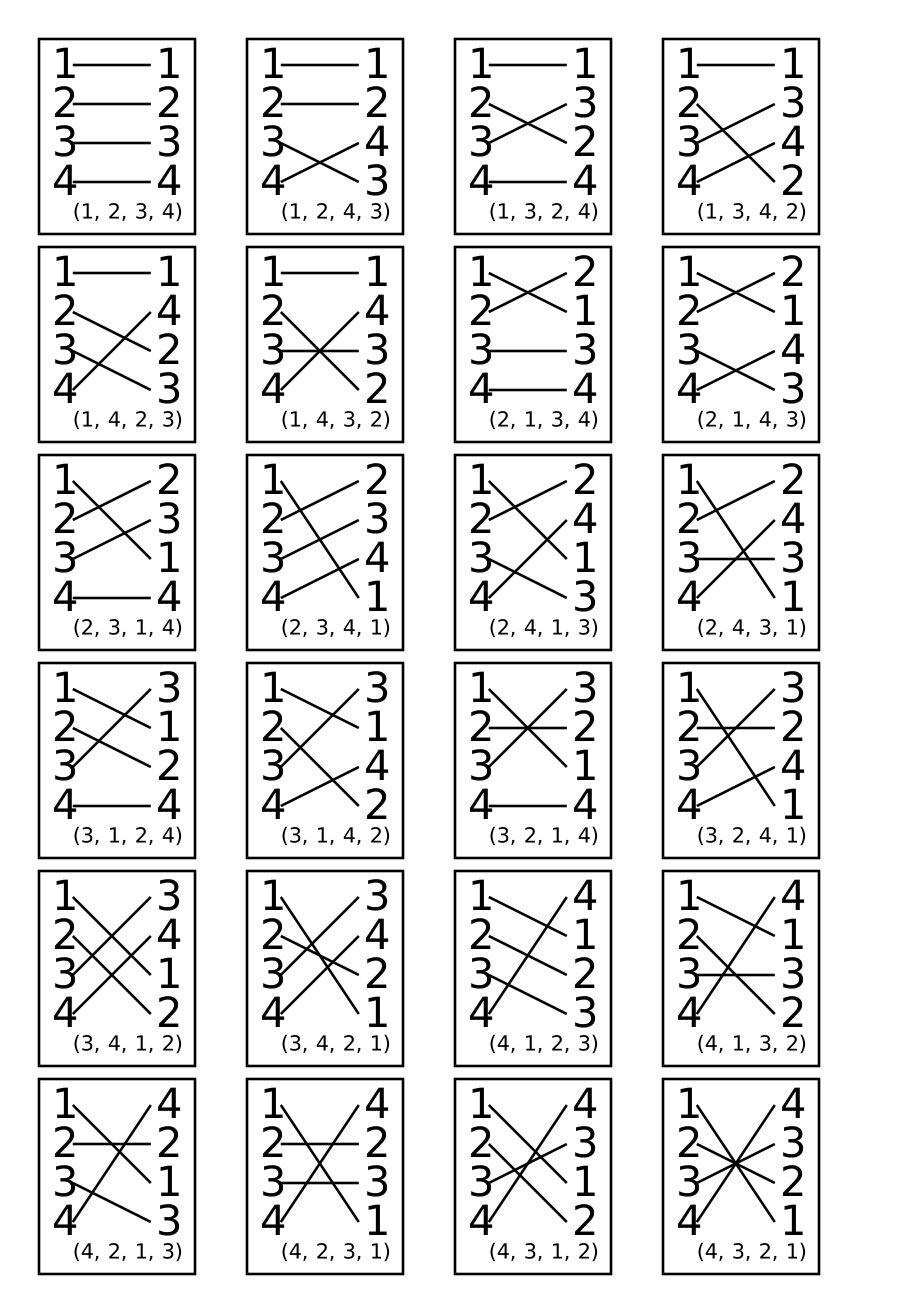
Permutations as Exchanges
- Permutations can be seen as ways to exchange elements
Example: For a tuple/list with two elements, there are two permutations:
- One permutation that keeps the same order: (1, 2)
- One permutation that changes the order of the elements: (2, 1)
- We denote such permutations by assuming we start with a tuple of the
first n integers ((1, 2,...)), and show the result of the
permutation
- Example: The tuple (cat, dog, horse, cow), when permuted with the
permutation (2, 4, 1, 3), results in (dog, cow, cat, horse)
Composition of Permutations
- When seen as exchanging elements, permutations can be composed
- We use ∘ to denote composition
- Example: (2, 4, 1, 3) ∘ (1, 4, 2, 3) = (2, 3, 4,
1)
- Composition of permutations can be show by using cards
- Cut out and use the cards at permutations.svg
Permutations as a Group
The permutations of sets of size n together with composition form
a group:
- All compositions of permutations result in another permutation
(i.e. permutations are closed under composition)
- Permutations are associative
- The identity element is (1, 2, 3, 4, ...)
- Each permutation has an inverse
Example: The inverse of (2, 4, 1, 3) is (3, 1, 4,
2)
- Commutativity does not hold
Example: (2, 4, 1, 3) ∘ (1, 4, 2, 3) = (2, 3, 4,
1)
(1, 4, 2, 3) ∘ (2, 4, 1, 3) = (4, 3, 1,
2)
- These groups are called symmetric groups
Sn and have order (size) n!
Representation of Finite Groups: Caylay Table
- Finite groups can be described using Cayley tables
- Cayley tables resemble multiplication tables
+
(mod 3) |
0 |
1 |
2 |
| 0 |
0 |
1 |
2 |
| 1 |
1 |
2 |
0 |
| 2 |
2 |
0 |
1 |
- Conventions:
- The left operands are used as the row headings
- The right operands are used as the column headings
- Both row and column headings use the same order
- The set and/or the operation is placed in the upper left corner
- The identity element is placed in the first (actual) row and
column
- If possible, the elements are listed in a 'natural' order
- Properties:
- The first row/column is the same as the headings (reason: identity
element)
- Each element of the set appears once in each row/column (reason:
cancellation law, see below)
- The identity element is distributed symmetrically to the diagonal
(reason: inverse element)
- Associativity has to be checked "by hand" (if not obvious from
operation)
Group Isomorphism
- Isomorphism is a one-to-one correspondence
- Two groups (G, •) and (H, ∘) are
isomorphic iff (if and only if):
- The elements in G and H correspond one-to-one
- The operation work exactly the same on corresponding elements
- More formally: Two groups (G, •) and (H, ∘) are
isomorphic iff there is a function f so that:
- ∀h∈H: ∃g∈G:
h = f(g)
- ∀g1, g2∈G:
g1≠g2 →
f(g1)≠f(g2)
- ∀g1, g2∈G:
f(g1•g2) =
f(g1)∘f(g2)
- If two groups are isomorphic
- They have the same number of elements (|G| =
|H|)
- They have the same structure
- From a mathematical viewpoint, they can be considered to be
the same
Examples of Isomorphic Groups
- Example 1: (ℝ, +) is isomorphic to (ℝ+, ·), with
f(x) = ax (any
a>1 defines an isomorphism)
- Example 2: Three isomorphic groups (shown as Cayley tables)
Example isomorphism from H to K: f(0)=0, f(1)=2,
f(2)=1
- Note: All groups of size three are isomorphic (to each other)
This is often also expressed as "there is only one group of size three"
| G |
e |
a |
b |
| e |
e |
a |
b |
| a |
a |
b |
e |
| b |
b |
e |
a |
| K |
0 |
2 |
1 |
| 0 |
0 |
2 |
1 |
| 2 |
2 |
1 |
0 |
| 1 |
1 |
0 |
2 |
| H |
0 |
1 |
2 |
| 0 |
0 |
1 |
2 |
| 1 |
1 |
2 |
0 |
| 2 |
2 |
0 |
1 |
Group Theory
- Groups are the best known example of Algebraic Structures
- Group theory has produced many interesting theorems and other results
- Examples of theorems:
- Uniqueness of identity
- Uniqueness of inverse
- Cancellation law
Group Theorem: Uniqueness of Identity
Existence of identity element (axiom): ∃e∈A:
∀b∈A: e•b =
b = b•e
Theorem: The (left) identity element of a group is unique
(∃c∈A: ∀x∈A:
c•x = x) ⇒ c = e
Another way to express this: There is only one identity element
(|{c|c∈A, ∀x∈A:
c•x = x)}|= 1)
Proof:
[assume c is an identity]
c•x = x [inverse axiom, closure]
(c•x)•x' = x•x'
[associativity axiom]
c•(x•x') = x•x'
[inverse axiom, on both sides]
c•e = e [identity axiom]
c = e Q.E.D. (similar proof for right idenity)
Group Theorem: Uniqueness of Inverse
Existence of an inverse (axiom): ∀b∈A:
∃b'∈A: b•b' = e =
b'•b
Theorem: Each right inverse is unique
Proof:
Start by assuming that there is some c (possibly different from
b') that is a right inverse to b:
b•c = e [applying b'• on the
left]
b'•(b•c) = b'•e
[associativity axiom]
(b'•b)•c = b'•e
[inverse axiom]
e•c = b'•e [identity axiom,
on both sides]
c = b'
This means that any c that is a right inverse of b is
the same as b', which means that b' is unique.
(∀b, c∈A: (b•c = e
⇒ c=b')) Q.E.D. (similar proof for left inverse)
Group Theorem: Cancellation Law
Theorem: ∀b, c, d ∈A:
(b•d = c•d ⇒
b=c) (right cancellation law)
Proof:
b•d = c•d [applying
d' on the right]
(b•d)•d' =
(c•d)•d' [associativity]
b•(d•d') =
c•(d•d') [inverse axiom, on both sides]
b•e = c•e [identity axiom,
on both sides]
b = c Q.E.D. (similar proof for left cancellation)
Corollary: b≠c ⇒ b•d ≠
c•d
This theorem shows that each element of a group can only appear once in each
column
(likewise, left cancellation shows that each element can only appear once in
each row)
Groups in Computer Science
Addition modulo n, in particular for n =
28, 216, 232, 264,...
Multiplication modulo n (see lecture 13)
Any group in any application area of Computer Science
This Week's Homework
Deadline: December 11, 2025 (Thursday),
18:30.
Format: A4 single page (using both sides is okay; NO cover
page), easily readable handwriting (NO printouts), name (kanji
and kana) and student number at the top right
Where to submit: Box in front of room O-529 (building O, 5th floor)
Homework 1: Create a Cayley table of the symmetric group
S3 (3!=6 elements). Use the notation introduced in this
lecture. Use lexical order for the permutations. Do not use any abbreviations.
Homework 2: If we define isomorphic groups as being "the same", there are
two different groups of size 4. Give examples of two groups of size 4 that are
not isomorphic, as a Cayley table. Hint: Check all the conditions (axioms) for
a group. There will be a deduction if you use the same elements/operations for
the groups as another student.
Glossary
- algebraic structure
- 代数系
- group
- 群 (ぐん)
- group theory
- 群論
- inverse element
- 逆元
- inverse, reciprocal
- 逆数
- symmetric group
- 対称群
- closure
- 閉性
- Cayley table
- 積表、乗積表
- multiplication table
- 九九 (表)
- isomorphic
- 同形の、同型の
- group isomorphism
- 群同形
- isomorphic
- 同形の、同型の
- row heading
- 行見出し
- column heading
- 列見出し
- lexical (or lexicographic(al)) order
- 辞書式順序